What if a building’s past could become part of its future?
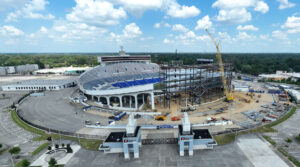
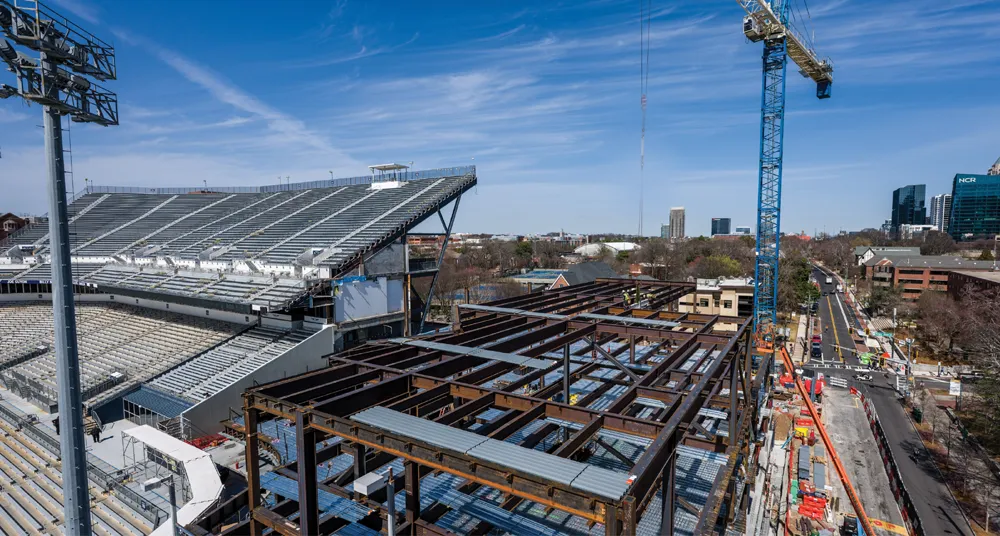
At the Georgia Institute of Technology, that idea came to life through an innovative steel reuse strategy tied to the construction of the Thomas A. Fanning Student-Athlete Performance Center. Rather than sending valuable materials to scrap, the project team took a more intentional approach—reclaiming and repurposing structural steel from the adjacent stadium.
Steel Reuse Strategy: Collaboration at the Core
Steel reuse was central to the success of the Fanning Center project, but achieving it required more than just good intentions—it demanded careful planning and consistent coordination from start to finish.
From the outset, a strong line of communication was established across all trades, including architect S/L/A/M Collaborative, general contractor DPR Construction, structural engineer Walter P Moore, demolition contractor Green Circle Demolition, and steel fabricator Steel, LLC. This collaboration ensured the reuse strategy was not only feasible, but executed effectively at every stage.
“The biggest difference was factoring in the time required for coordination and getting engagement from all parties as early as possible,” said Sarah Rohlfson, project engineer at DPR Construction. The team brought trade partners on board nearly a year before demolition or steel erection began—allowing time to align on sequencing, storage, and installation.
Early involvement proved critical. With guidance from Walter P Moore and Steel, LLC, reusable structural members were identified early, giving the team the ability to evaluate logistics, anticipate challenges, and incorporate accurate cost considerations into the preconstruction phase. This level of foresight also ensured proper subcontract language was in place, eliminating surprises later in the project.
Because of this proactive approach, the entire team remained engaged throughout the steel reuse process. That early and ongoing collaboration created a clear understanding of expectations, technical complexities, and logistical requirements across every discipline involved.
Turning Demolition into Opportunity
As portions of the existing stadium were removed, the team saw an opportunity to preserve and reuse viable steel members rather than discard them. Carefully selected components were extracted, stored, and ultimately integrated into the new facility—bridging the gap between past and future in a tangible way.
Building a More Sustainable Future
While recycling steel is common, direct reuse on this scale remains relatively rare. By reclaiming structural members and minimizing reprocessing, the project significantly reduced material waste and embodied carbon.
More importantly, it demonstrated what’s possible when collaboration, innovation, and sustainability align.
The finished facility stands as more than just a high-performance training center—it’s a forward-thinking example of how the construction industry can evolve. By embedding reused materials directly into the structure, the project proves that yesterday’s steel can play a meaningful role in building tomorrow.